
Top bookkeeping firms that deliver detailed financial reports for therapy practices
Many therapy practice owners get a profit and loss statement once a month, glance at it, and set it aside. The numbers don't explain why cash feels tight when revenue looks solid. They don't show which clinicians are actually carrying the practice and which are quietly draining margin. They don't account for the fact that the insurance payment for sessions billed 30 to 60 days ago still hasn't arrived. That's not a reporting problem you can solve by staring at your P&L. It's a support problem… you may have just outgrown your bookkeeper or accountant!
Here's the short version, if you just want the names ;)
Heard, Wellness Fi, and Golden Apple Agency serve solo therapists well with basic bookkeeping and standard financial statements.
GreenOak Accounting and CoCountant extend further toward group practices, with GreenOak in particular offering real infrastructure at that tier.
Focal Point Bookkeepers also works exclusively with mental health group practices, and its reporting goes deeper still: clinician-level P&L, payer mix analysis, cash flow forecasting tied to insurance reimbursement lag, and compensation ratio reporting, backed by advisory sessions that turn the numbers into decisions.
So which bookkeeping companies provide detailed financial reports for therapy practices, and how do you tell the difference between a firm that's therapy-adjacent and one that's genuinely built for behavioral health?
Several bookkeeping firms now market directly to therapists and group practice owners. They vary considerably in who they're actually built for, what reports they produce, and how deeply they connect financial data to real business decisions.
This article breaks down the firms that come up most often in this space, what their reports actually contain, and how to match your practice size to the right level of service. Focal Point, a bookkeeping and financial advisory firm built exclusively for mental health group practices, is one of the specialists in this category, and you'll see exactly how it compares.
Full disclosure… this is Focal Point's blog, and we're one of the firms compared here. We've tried to describe everyone fairly, including where other firms are a great fit.
What useful financial reports for a therapy practice actually look like
Most bookkeepers deliver three standard statements:
a profit and loss
a balance sheet
and (sometimes) a cash flow statement.
For a solo practice with straightforward finances, that's typically enough. For a group practice managing multiple clinicians, insurance panels, and payroll, those three statements describe what happened without telling you what to do about it. The reports that actually move the needle go deeper…
5 reports that help you make decisions as a group practice owner
Before any of these, every group practice needs a solid foundation: a P&L that clearly shows gross profit and operating profit, a budget to measure performance against, and trends tracked month over month. For practices under about ten clinicians, that foundation, often pulled together in a simple KPI dashboard that tracks session volume, collections rate, and profit side by side, answers most of the questions that matter. As the practice grows, the decisions get bigger and more specific, and these five reports are what turn the numbers into answers.
P&L by clinician. Breaks out revenue, direct costs, and net contribution for each provider, so you can see who is profitable and by how much. It takes real setup work, restructuring how revenue and payroll are captured so each clinician's numbers can be isolated, which is why it usually earns its place once a practice reaches ten or more clinicians. At that size, it keeps compensation decisions from being based on averages and gut instinct.
Detailed cash flow forecast. Maps expected insurance and self-pay collections against fixed and variable expenses, week by week or month by month. This matters enormously in behavioral health because insurance reimbursement lag means revenue you earned this month may not arrive as cash for 30 to 60 days. Which means, your P&L can look fine while your bank balance is tight and causing stress.
Payer mix report. Shows how much revenue comes from each insurance panel versus self-pay, and what each actually pays per session once collections are in. It's the report behind decisions about dropping a low-reimbursement panel, negotiating rates, or shifting toward more self-pay.
Break-even analysis. Starts by separating fixed costs like rent, software, and admin salaries from variable costs, then shows the revenue, or number of sessions, the practice needs to cover them. It answers questions like how many sessions a new clinician needs to see before they cover their own cost, or what adding office space does to your margin.
Compensation ratio report. Tracks clinician compensation, including payroll taxes and benefits, as a percentage of collected revenue, overall and by provider. Compensation is usually the largest line on a therapy practice's P&L, so this ratio shows whether your pay structure is sustainable before you commit to raises, benefits, or a new hire.
This is where working with a specialized bookkeeping and advisory firm can be well worth it, far beyond basic recordkeeping.
Here’s an example of a KPI Dashboard we use with our clients.
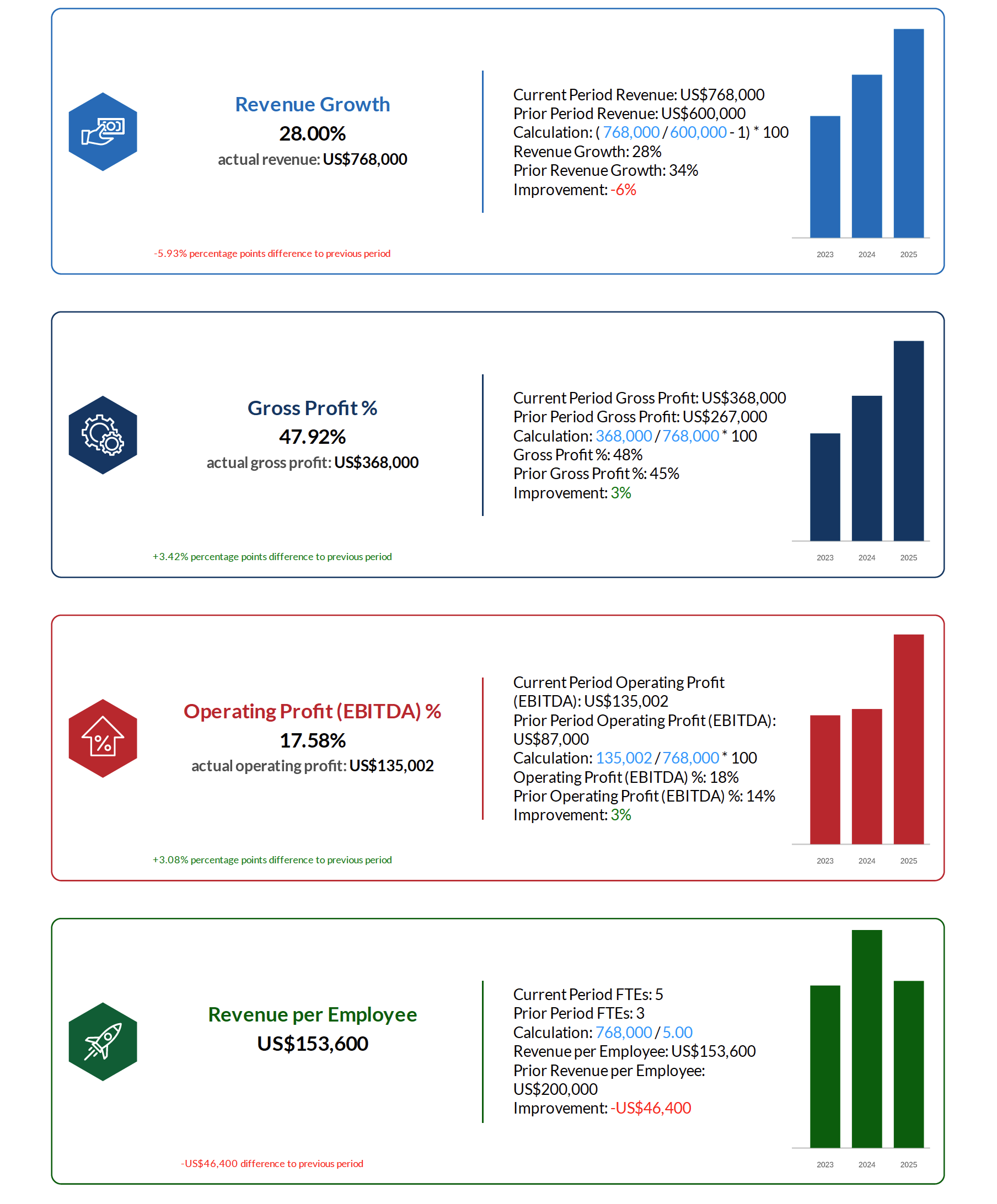
Focal Point Bookkeeper’s KPI Dashboard for Group Practice Owners
What a clinician-level P&L actually looks like in practice
Here's an example: imagine a practice with fourteen clinicians, two of whom appear equally productive on paper. A clinician-level report might show one contributing a 34% net margin and the other contributing 18%. Understanding why that gap exists and how to close it makes a real difference. It allows owners to have a real conversation about caseload mix, billing rates, and which insurance panels each clinician accepts. A generic bookkeeper running standard statements will rarely surface that kind of information.
Which bookkeeping companies provide detailed financial reports for therapy practices?
Several firms have positioned themselves as specialists for therapists. Knowing who each one is actually designed to serve helps you avoid paying for a service that doesn't fit your stage of growth.
Firms focused primarily on solo and small private practices
Heard works with solo practices, group practices, and S-corps, and its done-for-you bookkeeping is a reasonable choice for a practice that needs clean books and basic financials. But the reporting stays fairly basic: P&L statements, balance sheets, and an owner-allocation guide for taxes and pay. There's no clinician-level breakdown, no payer mix analysis, and no cash flow forecasting tied to reimbursement timing — the kind of reporting a group practice owner needs to make comprehensive, whole-picture decisions rather than just see where the money went.
Wellness Fi similarly markets to therapists and psychologists, with monthly P&L statements, bank reconciliation, and quarterly tax estimates as its core deliverables. The positioning is clearly toward solo practices rather than group practices managing a clinical team.
Golden Apple Agency is the most transparent about report deliverables in this category, explicitly listing balance sheet, cash flow statement, and profit and loss among its offerings. It serves therapists and small practices, and for practices at that size, the reporting scope is appropriate. None of these solo-focused platforms, however, are built for the operational complexity of a growing group practice.
Firms that work with group practices and growing clinics
GreenOak Accounting works with both solo and group practices, with tiered packages that scale up to a CFO-level service for larger practices, including monthly financial reports, KPI benchmarking, and regular review meetings. One notable difference: GreenOak builds its approach around Profit First, a system that allocates revenue across multiple bank accounts by percentage. For those who love that system, GreenOak is a great choice.
For owners who've tried it and found the account-and-transfer system more than they wanted to maintain, our approach is simpler: tracking your own practice's trends month over month, comparing them to healthy benchmarks, and working from goals and a budget-versus-actual view.
CoCountant markets bookkeeping and financial reporting to therapists and mentions financial reporting as a deliverable, but its publicly available materials don't detail specific report types, which makes it difficult to evaluate the depth of what it actually produces.
Where most of these firms fall short for growing group practices
Solo-focused platforms are often not equipped for practices managing three to twenty-five clinicians. Clinician-level P&L reports, Gusto payroll reconciliation, insurance panel strategy, and owner compensation modeling require a fundamentally different service structure than what platforms like Heard, Wellness Fi, and Golden Apple Agency typically offer. GreenOak Accounting has built real infrastructure for this tier too, with its own benchmarking and CFO-level packages. Where Focal Point differs isn't that it's the only firm serving group practices — it's the combination of working exclusively with mental health group practices, HIPAA-compliant workflows, Enrolled Agent-backed tax support, and a reporting suite built specifically around the decisions behavioral health owners face.
How Focal Point Bookkeepers delivers reports that actually drive decisions
Focal Point Bookkeepers works exclusively with mental health group practices, specifically owners with 3 to 25 clinicians operating in the mid-six to seven-figure revenue range. That focus means every report is designed around the decisions a group practice owner actually faces: whether to hire another clinician, whether to drop a payer, how to structure owner compensation without triggering tax problems.
HIPAA-compliant books on QuickBooks, delivered on a regular cadence
We run weekly to monthly reconciliation inside QuickBooks, keeping the books current and audit-ready year-round. Financial data is handled in a HIPAA-compliant workflow, which matters for any firm operating inside the financial infrastructure of a therapy practice. Reports are delivered on a consistent schedule so practice owners aren't waiting until tax season to understand where they stand. That reconciliation cadence is more frequent than what many standard bookkeeping firms provide, keeping the books tighter and decisions better-informed.
The full reporting suite and what each report answers
Focal Point's reporting builds with the practice. Every client gets a clear view of gross and operating profit, budget-versus-actual, and month-over-month trends. As practices grow, that expands into clinician-level P&L, cash flow forecasting, payer mix analysis, break-even analysis, and compensation ratio reporting. Each report is built to answer a specific operational question. A payer mix report, for instance, doesn't just describe your current revenue split. It surfaces whether dropping a low-reimbursement panel would actually improve net margin once you account for the volume that panel represents.
Here's a hypothetical scenario to make that concrete: a group practice owner with seven clinicians is weighing whether to add a health benefits package but isn't sure if there’s enough margin to cover it. Running the numbers through a break-even analysis and compensation ratio report might show the practice could cover health benefits for W-2 clinicians by adjusting one clinician's panel mix and raising the self-pay rate by $15 per session. That kind of decision gets made with numbers, not a feeling, and it's the type of scenario modeling that separates advisory-led bookkeeping from basic recordkeeping.
HIPAA compliance and software integrations: what to verify before signing
Bookkeeping for a therapy practice isn't purely a financial function. Financial records in this context sit adjacent to sensitive billing and client data, and not every firm has thought carefully about what that means. Ask whether the firm signs a BAA, how financial data is stored and transmitted, and whether staff receive HIPAA training.
QuickBooks and Gusto: the integration that keeps payroll and books aligned
The most common failure point in therapy practice bookkeeping is a disconnect between payroll and the general ledger. When the bookkeeper and the payroll processor aren't coordinating, benefits deductions, S-corp distributions, and employer tax rates can easily differ between systems. We run payroll through Gusto and reconcile it against QuickBooks every cycle, with one team owning both sides of that relationship. If you're evaluating any other firm, ask specifically how they handle that reconciliation and who owns it when something doesn't match.
What to ask a vendor about HIPAA and data handling
Even when a bookkeeping firm doesn't access clinical records directly, their engagement with a therapy practice can bring them into contact with billing data that warrants a business associate agreement. Ask whether the firm signs a BAA, how financial data is stored and transmitted, and whether staff receive HIPAA training. A firm that can't answer those questions clearly is a firm that hasn't thought through the environment they're operating in. For a mental health practice, that's not a minor oversight.
Pricing tiers and what's actually included at each level
Based on publicly listed pricing and our own work with group practices, service generally falls into three tiers. Understanding what each tier delivers helps you evaluate whether a firm's pricing reflects real service depth.
Outsourced bookkeeping ($95 to $450/month): Transaction categorization, monthly reconciliation, and standard financial statements. This is where most therapist-focused platforms operate, serving solo practices and early-stage groups. Advisory support is minimal or absent.
Advisory-led service for group practices (roughly $750 to $1,500/month): KPI dashboards, gross and operating profit tracking, budget-versus-actual reporting, and quarterly or twice-yearly strategy sessions that help you scale your practice sustainably.
CFO-level support for group practices (roughly $1,500 to $3,000+/month): Clinician-level reporting, benchmarking against industry data, cash flow forecasting, and monthly strategy sessions that provide ongoing financial guidance.
The "CFO" label gets used loosely in this space, so compare what's actually included, not the title on the package :)
Our packages include decision modeling and scenario forecasting alongside the bookkeeping itself. That means regular video planning sessions where reports are translated into concrete decisions: whether to bring on another clinician, whether a particular insurance panel is worth keeping, how to structure owner pay across the year. For a group practice owner making high-stakes financial calls without reliable data, that advisory layer is often worth more than the bookkeeping itself.
Matching provider to practice size: a simple decision framework
Not every practice needs the same reporting depth. The right firm depends on where you are right now and where you're headed.
Solo clinicians and practices with 1 to 2 clinicians
At this stage, you need clean books, basic financial statements, and solid tax prep. Solo-focused platforms like Heard or Golden Apple Agency are reasonable starting points. The reporting complexity is manageable, and the price point matches the revenue level. The tradeoff is you're basically paying for software and not for human support, but at this stage, the cost of more human support usually outweighs the benefit for many solo practitioners.
Small group practices with 3 to 9 clinicians
This is where generic bookkeepers start to fall short. You're coordinating payroll and beginning to make real decisions about hiring, rates, and owner compensation. At this stage, you need clear answers to a few core questions: what your gross and operating profit actually are, how you're tracking against a budget, and whether the trend is moving in the right direction. Clinician-level detail usually isn't the priority yet. An advisory-led firm that builds that foundation, with KPI dashboards and regular strategy sessions, gives you what you need without paying for analysis you won't use yet. Focal Point Bookkeepers is built for this stage, and for the one that follows.
Growing group practices with 10 to 25 clinicians
At this scale, your financial reporting directly shapes every significant business decision. Clinician-level P&L, cash flow forecasting, payer mix analysis, break-even analysis, and compensation ratio reporting are not optional features… they're the core of how you run the business. You need a firm that speaks the same language as your practice manager, understands the reimbursement dynamics of behavioral health, and delivers reports that connect to your next move. This is where a specialized firm like Focal Point Bookkeepers provides the clearest return on what you're spending.
Frequently asked questions: bookkeeping companies and detailed financial reports for therapy practices
Which bookkeeping companies provide detailed financial reports for therapy practices?
Firms that specialize in behavioral health, including Focal Point Bookkeepers, GreenOak Accounting, and Heard, market directly to therapists, but their reporting depth varies significantly. Solo-focused platforms typically offer standard P&L, balance sheet, and cash flow statements. Group-practice specialists like Focal Point and GreenOak go further than solo-focused platforms, though the specific reports vary by firm; Focal Point's suite includes clinician-level P&L, payer mix analysis, cash flow forecasting tied to reimbursement cycles, and compensation ratio reports designed around the decisions group owners actually face.
Do I need a CPA, or is a bookkeeping and advisory firm enough?
It depends on what you need. A bookkeeping and advisory firm can handle accrual-basis accounting, complex reporting, journal entry adjustments, and balance sheet reconciliation — the ongoing work that shows you what's actually happening in the business. Tax filing and IRS representation don't require a CPA either: an Enrolled Agent, federally licensed specifically in taxation, can prepare and file returns and represent you in an audit or collections matter, just as a CPA can. Where a CPA becomes necessary is a narrower, specific service: producing audited or reviewed financial statements under formal assurance standards. That typically comes up in specific situations like applying for an SBA loan above a certain size, bringing on an outside investor, or selling your practice.
What should I look for in a therapy practice bookkeeping firm's reports?
It depends on your practice's size. For practices under about ten clinicians, look for a P&L that clearly shows gross and operating profit, budget-versus-actual reporting, and month-over-month trends. As you grow past that, look for clinician-level P&L, a cash flow forecast that accounts for insurance reimbursement lag, payer mix analysis, break-even analysis, and compensation ratio reporting. At any size, the strongest sign of depth is advisory sessions that turn reports into concrete decisions.
How much does bookkeeping for a group therapy practice cost?
It depends on the level of support. Outsourced bookkeeping, which covers transaction categorization, reconciliation, and standard financial statements, typically runs $95 to $450 a month. Advisory-led service, which adds KPI dashboards, profit tracking, budget-versus-actual reporting, and periodic strategy sessions, generally runs $750 to $1,500. CFO-level support, with clinician-level reporting, cash flow forecasting, and monthly strategy sessions, typically runs $1,500 to $3,000 or more. Most group practices under ten clinicians get the most value from the advisory tier, and CFO-level support tends to pay off as the practice grows past that point.
The right reports change how you run your practice
Generic financial statements tell you what happened last month. Clinician-level P&L, cash flow forecasts tied to reimbursement cycles, payer mix breakdowns, and compensation ratio reports tell you what to do next. When evaluating which bookkeeping companies provide detailed financial reports for therapy practices, the key question isn't just what reports they list, it's whether those reports are built around the operational decisions a group practice owner actually faces. Several firms in this space serve therapists, but few are purpose-built for group practices navigating real growth decisions. If your practice has three or more clinicians and you're making financial calls without detailed reports behind them, that's the problem worth solving first.
Focal Point Bookkeepers is built for exactly this work: HIPAA-compliant books, therapy-specific reporting, and advisory sessions that translate your numbers into your next move. If you're ready to see what your practice's financials actually look like when someone builds the reports around your business instead of a generic template, reach out to our team to start the conversation.
